Exosome Science & Signaling
Unlocking the paracrine vectors of MUSE extracellular vesicles. ExoTec™ serves as a key platform for cellular pathway mapping and preclinical models.
FROM FORMATION
TO TARGET.
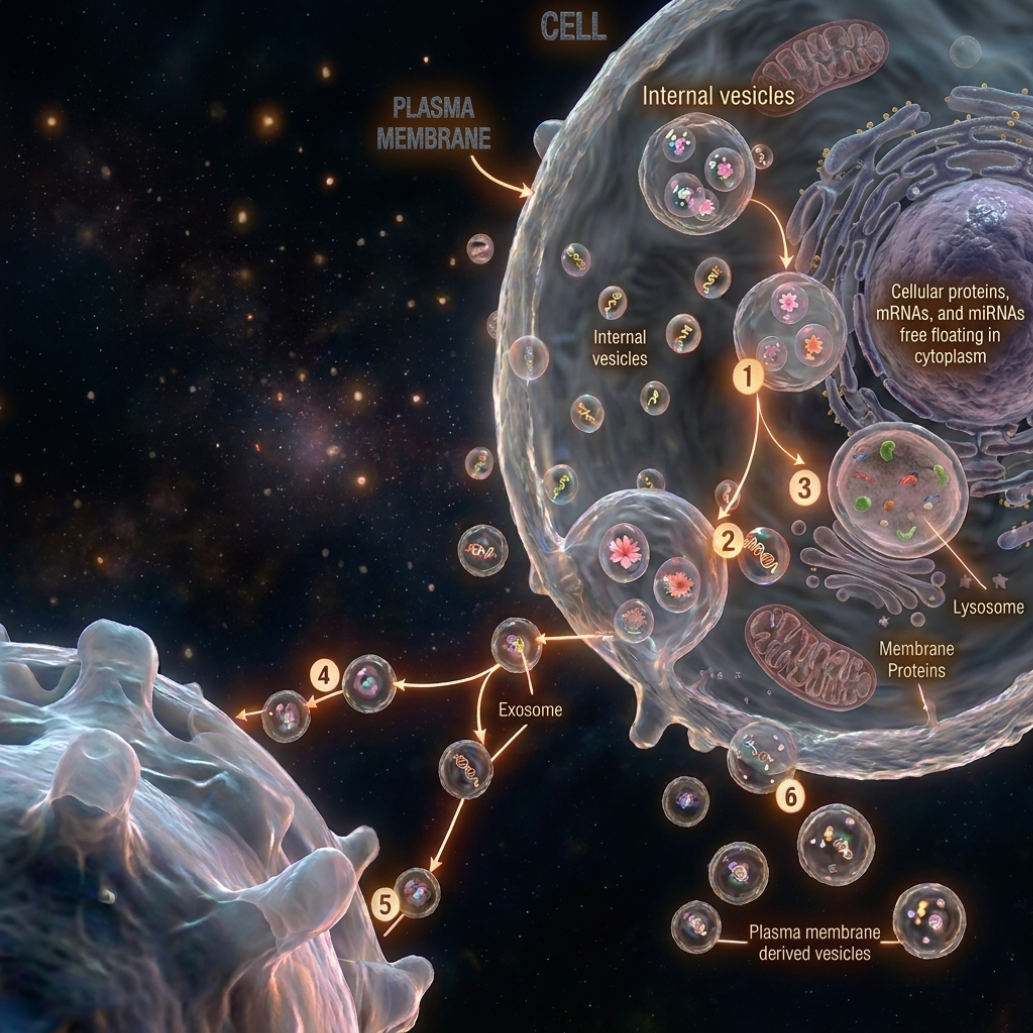
Vesicle Release
01These internal vesicles are released as extracellular vesicles when MVE fuse with the cell membrane.
Lysosomal Fusion
02Alternatively, MVE can fuse with lysosomes, which degrade MVE contents.
Target Recognition
03Upon reaching their destinations, usually determined by the binding of specific ligands on their surfaces, vesicles can enter target cells in one of two ways: by being taken up by the target cell's endocytic pathway.
Membrane Fusion
04Or by fusing to the target cell's membrane and releasing its contents directly into the cytoplasm.
Vesicle Secretion
05Cells also secrete other membrane-derived vesicles, such as ectosomes, shed vesicles, or macrovesicles, which bud directly from the cell's plasma membrane.
Active Transport
06These vesicles are also known to carry active proteins and RNAs, as well as some compounds specific to the source-cell profile, but little is known about their effects on distant tissues.
Research
Areas.
MUSE Exosomes are being investigated across multiple research areas because of their role in cell-to-cell communication and stress-response signaling. The applications below describe investigational research directions only and should not be interpreted as approved clinical uses.
Origin & Mechanism
MUSE Exosomes are extracellular vesicles derived from multilineage-differentiating stress-enduring cells. Their biological cargo may include proteins, lipids, nucleic acids, and microRNAs that support intercellular signaling. Research interest focuses on oxidative-stress response, anti-apoptotic signaling, immunomodulatory signaling, and tissue microenvironment support. Final claims must be based on verified source-cell identity, cargo characterization, and lot-specific quality data.
Investigational Applications
MUSE Exosomes are being studied for potential roles in regenerative biology, inflammatory signaling, cellular stress response, skin and tissue-support research, and advanced extracellular-vesicle delivery systems. These applications remain investigational unless reviewed and approved by the relevant regulatory authority.

MUSE Exosome Research Areas
MUSE Exosomes are being studied for their role in cellular communication, oxidative-stress balance, and tissue microenvironment support. Research may explore how Muse-Exos influence collagen-related signaling, cellular repair pathways, and skin biology.
MUSE cell-derived exosomes are being investigated for their potential influence on inflammatory and immune-signaling pathways. This research does not imply treatment of autoimmune disease and should be described only as investigational biology.
Extracellular vesicles are widely researched as delivery systems and biomarker platforms. MUSE Exosomes may be explored for cargo delivery, target-cell interaction, and diagnostic research, depending on verified composition and manufacturing controls.
Research into MUSE Exosomes may examine how their biological cargo interacts with inflammatory pathways, oxidative stress, and tissue microenvironments. Do not claim treatment of Lyme disease or chronic inflammatory disease.
MUSE Exosomes may be studied for their effects on scalp and follicle microenvironment signaling, angiogenesis-related pathways, and regenerative communication. Do not claim guaranteed hair regrowth.
MUSE Exosomes are being explored as part of advanced regenerative biology research because of their role in intercellular communication, stress-response signaling, and tissue-support mechanisms.
1. Intercellular Communication Networks
Extracellular vesicles (EVs), specifically exosomes, act as targeted messengers between cells. By encapsulating complex cargo (microRNAs, proteins, transcription factors, and mRNA) within a protective lipid bilayer, exosomes prevent enzymatic degradation in the extracellular space. This enables long-range paracrine signaling, modifying the transcriptomic and phenotypic profiles of recipient target cells.
2. Stress-Response & Survival Signaling
Multilineage-differentiating stress-enduring (MUSE) cells exhibit high resistance to physiological stress. Exosomes secreted by these cells transfer this stress-tolerant coding to target tissues. Research suggests validation of Wnt/β-catenin and PI3K/Akt activation, which promotes tissue survival, controls local inflammatory profiles, and modulates cellular senescence models.
Research Use Only (RUO) Notice
All biological activities, cell migration effects, and pathway interactions described herein are observed within ex vivo and in vitro laboratory models. These research descriptions do not constitute medical claims for clinical efficacy or human therapeutic safety.